Real Life in Divine Places

Sarah Garcia • August 22, 2025

Dreaming is a necessary ingredient for any beautiful creation or meaningful life

We’ve long been enchanted by the promise of transcendence — a natural and deeply human desire. The spirit of overcoming is foundational to Joseph Campbell’s Hero’s Journey, religious doctrines with the largest followings, and more concretely, the American Dream. Possibilities of enlightenment, ascension, or liberation compel us to imagine beyond our circumstances. Such dreaming is a necessary ingredient for any beautiful creation or meaningful life — often associated with divinity or, at least, the mechanism of evolution.


Sometimes, in James Hollis’ language, when making our way through “the complex thickets of choice,” we discover that we are reacting with a transcendent impulse, rather than harvesting self-insight and collective wisdom in service to the ascension of soul or Self. The unconscious pursuit of transcendence yields variations of human shadow — spiritual bypassing, outright denial of human vulnerability, careless self-advancement, megalomania, grandiose entitlement, fateful self-denial, or intergenerational sabotage through destruction of resources — all with their unique contribution to personal and collective symptoms. These failing attempts at control and perfectionism are actually expressions of resistance which mask and stifle the potential for life-affirming transformation.


It’s absurd and hilarious that we do this! It reminds me of Jesus in Gethsemane — being so fearful and avoidant about his impending transformation. Okay — fair enough — he’s literally about to be crucified. Ultimately, his resistance to suffering reveals his mortal vulnerability- it’s endearing and inspiring- as he stays the course. And it is a reminder that the practice of change isn’t about the absence of fear or resistance, but about maintaining integrity through it. As seekers, we’re ignited with spiritual yearning but continually bound by earthly design and human imperfection. Reaching above the treetops, or finding sustained enlightenment, is reserved for few. For others, meaning, beauty, and truth are found only in a deeper place — through profound interconnection. Spaces between heaven and soil are windy, rocky, fiery, or watery — perilous pathways supported by helping hands, tools, and instinct. Circumstances which contain this archetypally transformative landscape include the midlife threshold, identity or existential crisis, grief and loss, and of course, bodily death — all messy and numinous endeavors.


Immersed in the liminal, we aim to honor the promise of transcendence, while integrating our human nature. This Fall, our programming bridges the two in a variety of ways:


  • In September, “Death in Collectivist Cultures” illuminates relational dying – in contrast to our highly medicalized and monetized Western tendencies, alongside a practical discussion for understanding our identities and coping capacities within the “sandwich generation.”
  • In October, we go deeper with “Making Peace with Aging,” an exploration of how we hold the tension of somatics and spirituality in an older body, and a book study on Finding Meaning in the Second Half of Life — a guidepost for those traversing a powerful — and notoriously unmapped phase.
  • In the flux, November provides an opportunity for grounding through “Mindful Practice with Nature,” followed by insights to support conscious, ascending, and rooted growth-yielding realizations which tend to imply deliverance in lieu of stagnancy. “Menopause as Psychic Rebirth” elucidates the art of alchemical processes and offers a personal entry point to the journey of aging. Our voyages are never entirely solitary — Sharon Blackie joins us for “Hags and Wise Women: Older Women In European Myth and Fairy Tales,” where we’ll dive into the collective wisdom gleaned only through community, intimacy with Earth, and feminine archetypes.
  • Our season closes in December with a Lunch & Learn interlude through the phantasmal and utterly human experience of shadowy grief — alongside an invitation to light with “Turning Pages,” our annual celebration at The Jung Center bookstore. Along the way, there are opportunities for community connection following the programs which you find most resonating.


As Clarissa Pinkola Estés notes, “Even raw and messy emotions can be understood as a form of light, crackling and bursting with energy. All emotion, even rage, carries knowledge, insight, what some call enlightenment. Our rage can, for a time, become teacher.” The Community for Conscious Aging welcomes you to our space for human vulnerability, raw realization, messy but illuminating growth, and loving connection. Here, we welcome the surrender of pretense — or whatever obstructs your authentic expression — in favor of something more true, something both real and divine.


Sarah Garcia

Manager, Community for Conscious Aging


photo by Sarah Garcia

Share

Recent Posts
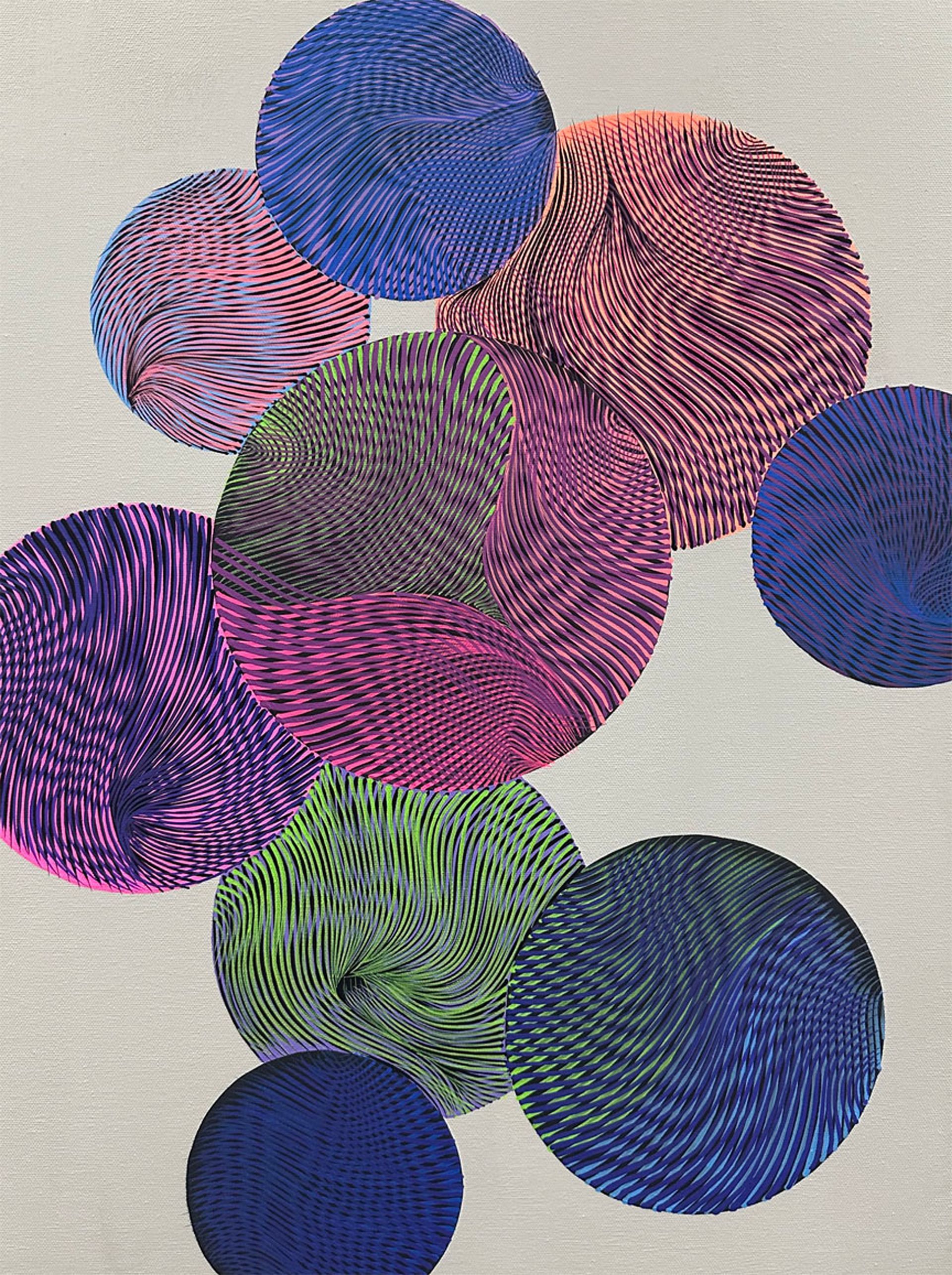
Overlapping circles in shades of blue, purple, pink, green, and orange against a light gray background with textured appearance.
By Alvia Baldwin February 16, 2026
In my professional life, I am the Director of Counseling for Alief ISD, one of the most culturally diverse districts in Texas, with our students speaking over 85 languages. In my personal life, however, I am like many of you—a spouse, a parent and grandparent, a sibling, a daughter, and, always, a champion for mental health. During the height of the pandemic, all of those roles were stressed, strained, and stretched. In my professional life, I was feeling those same pressures, especially as I led our District Crisis Response Team (DCRT), which is deployed throughout our district when there is a death of a staff member or student. Last school year, when I had the great fortune to become more acquainted with The Jung Center through the generous support of H-E-B, our DCRT was being requested more and more frequently to support issues of death, grief, and loss. I became increasingly concerned that my team of amazingly dedicated counseling professionals may begin to give way to compassion fatigue and burnout. I shared my concerns with The Jung Center team, and Dr. Sean Fitzpatrick and Dr. Alejandro Chaoul created a dynamic two-day training for our team. I vividly remember that before the first day ended, there were already members of my team in tears as they expressed in small groups some of the collective toll of trying to balance work and home, and how it was impacting their emotional wellness. Over those two days, The Jung Center provided us space and understanding as they walked us through self-care versus community care, how to combat burnout, and mindfulness techniques among other tools, reminding us to navigate life in healthy ways. And if that was not enough, The Jung Center returned to present a full-day workshop to over 100 of our amazing school and district nurses, who, at the time, had conducted more than 25,000 COVID tests over nearly a two-year period, always with a warm smile—while understanding that every interaction could have put them at personal risk. During their “Day of Care for the Caregivers,” as we coined it, the nursing staff kept coming up to me and saying, “I can’t believe someone did this for us. Someone did this just for us.” Since then, The Jung Center has sought and received funding from The Junior League to return to Alief. This year, Jasmine Shah and Dr. Fitzpatrick led two workshops for our counseling team as well as a full-day workshop for our district and school nurses. So, when I think about the impact The Jung Center had in Alief ISD, I think about the thoughtful support and stellar resources that The Jung Center provided for our counseling and nursing staff to ensure that we were emotionally healthy while we cared for ourselves and others. For that, we, along with the over 40,000 students that we serve, say, “Thank you!”
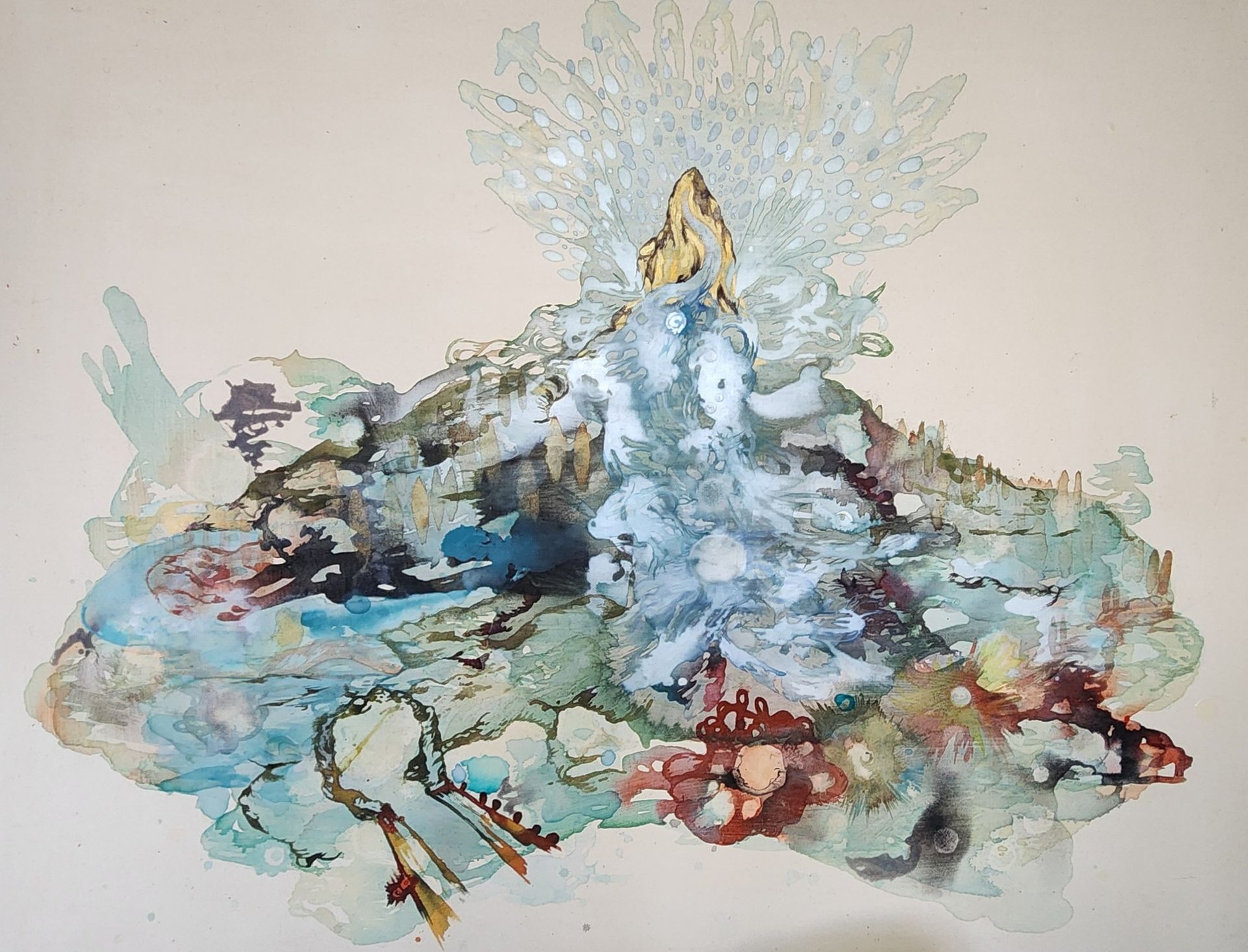
Abstract watercolor art; blues, greens, and browns blend, with a central, light-colored figure and radiant halo-like shape above.
By Karleen Koen February 2, 2026
When I had passed midlife but didn’t quite think of myself yet as old, I came across a quote from Carl Jung: “No, thoroughly unprepared we take the step into the afternoon of life; worse still, we take this step with the false assumption that our truths and ideals will serve us as hitherto. But we cannot live the afternoon of life according to the programme of life’s morning; for what was great in the morning will be little at evening, and what in the morning was true will at evening become a lie.”* The words hit me in some truth center of my being. They clarified feelings of unease, displacement, restlessness, uncertainty—quiet and deep—that had been building in me since midlife. They gave me the beginning of a way to age differently from what I had seen modeled in my family and the culture around me. Family— despair and bitterness. Culture—Botox and pills. And then I stumbled onto the beginning of the Community for Conscious Aging at The Jung Center. It became a home with fellow sojourners in this journey that we all face: growing old and dying. How does one do that in a way that is vital and purposeful, willing and willful—creative, and real, and in community? How does one live from midlife onward when the way ahead is unclear and goals of the past may no longer work as well as once they did? There is no ritual or meaning out there to help me move into this. Carl Jung writes in his essay “Stages of Life” that there is no university for midlife onward, but I feel like the Community for Conscious Aging gives me what I need. I find knowledge and advice. I find people who are on the same journey as I am, or even ahead of me. I find community. I’ve attended free programs, as well as book studies and workshops. Every month, I can hear a speaker over Zoom talk about some aspect of aging, from the practical to the esoteric. The talks are called Lunch & Learns, and they are free. I’ve learned about everything from how to age in place, to what records and documents I need done before I die, to the fact that “my kids don’t want my stuff” and the practice of Swedish death cleaning. This spring, my Lunch & Learn choices are: “Understanding Death in a New Way,” “Ethical Wills,” and “Stories We Inherit.” This spring, I can attend workshops like “Letter to My Children on Inheritance,” “Positive Aging: The Spirituality of Later Life,” or “What Matters Most: How Can We Accept Mortality?” I can meet in circles to talk deeply about anything and everything. I can go to a Jung Center Gallery Artist Talk to learn that creativity is ageless. And being part of The Jung Center means programs exist in its other divisions— The Mind Body Spirit Institute, Creating Your Life, The McMillan Institute for Jungian Studies—that cross over to enrich and feed my life. I’m now 77. I am climbing the high mountain whose summit I cannot see but know is there. Two of my sherpas and guides are the Community for Conscious Aging and what it offers, followed by The Jung Center itself with all its riches. *“The Stages of Life”, The Structure and Dynamics of the Psyche (Collected Works of C.G. Jung, Vol. 8)
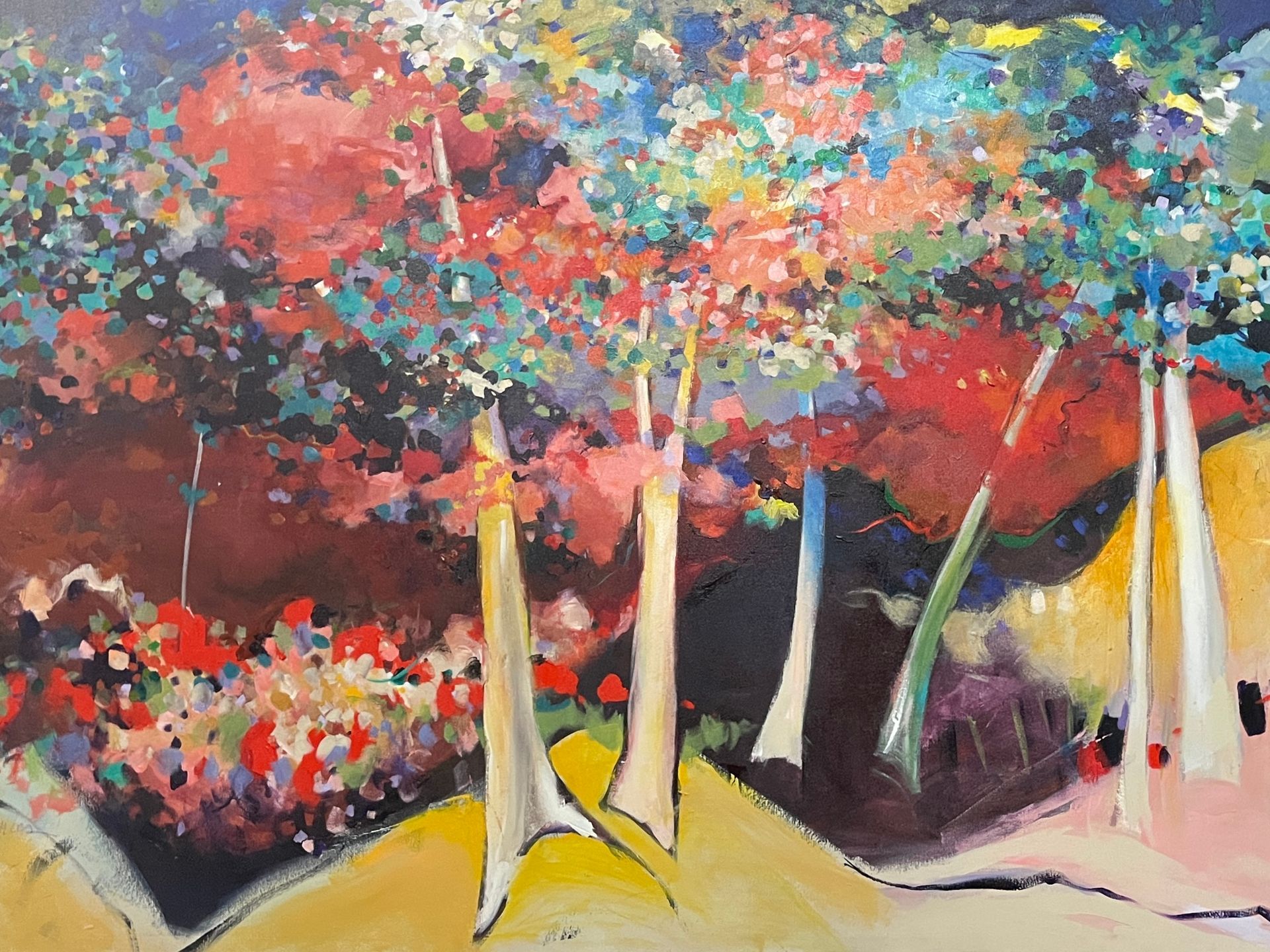
Colorful abstract painting of trees in a landscape. Reds, blues, and yellows dominate.
By Lois F. Stark January 5, 2026
When I was twelve years old, my father took me by one hand. In his other hand, he held a telescope. He led me to our backyard, where he had set up a tripod. As he positioned my eye to the scope, he asked, “Can you imagine what life on other planets might be like?” He was teaching me to wonder as much as he was teaching me astronomy. Telescopes allow us to see the unseen in stars and planets. Imagination is also a telescope for the unseen. My father pointed out the shape of the Little Dipper with its handle ending in the North Star. Once you know north, you can navigate the globe. Thinking back to that moment, he was showing me how to zoom out to infinity, how to zoom out to the possibilities imagination brings, and how to zoom in to the clue that is always available—how to find north. You can be lost in the wonder of infinity and still find your place on Earth. I followed his prompts to zoom out, to practice seeing things from above. When I was in high school, Sputnik went up. This Russian satellite was the first to enter space. It kicked off a space age, a scientific race, and a new worldview—seeing Earth from above. At that moment, I knew immediately what I wanted to be. It was not an astronaut. I wanted to be a “space lawyer”. I wanted to invent the terms that would bring agreement to the biosphere, as admiralty law did for the oceans. I imagined space law as the next iteration of the United Nations. I did not become a space lawyer, but I still practiced zooming out. I joined NBC Network News in Washington, D.C., and made documentaries in Liberia, Abu Dhabi, Israel, Northern Ireland, Cuba, and other countries in tension and transition. Filming foreign cultures was another way to see the unseen, to experience the wild variety of ways to live in this world. Just as the Big and Little Dipper use shape to key us to the stars, I started to think of shape as a way to understand human history. I remembered that when I filmed in tribal cultures, their shelters, social systems, and sacred sites were all circular, from round thatched huts to Stonehenge. When I filmed in cities, it seemed a ladder dominated their worldview, from pyramids to skyscrapers. Today, the network model masters our global lives, from technology to the map of our brain. These thoughts led to my book, The Telling Image: Shapes of Changing Times . Throughout my life in Houston, I came to The Jung Center as the place to understand the shapes and patterns in human history and in my own life story. I took courses in mythology and fairy tales, studied my night dreams and daydreams, researched symbols and wrote poetry, and took courses in the history of human ideas. The Jung Center is a place of learning, though not a school. It is a center that addresses spirit and mystery, though not a house of worship. It is a place of creative arts, though not a museum. The Jung Center offers us ways to see the unseen, to zoom out to the universe, and to zoom into ourselves.
Show More